
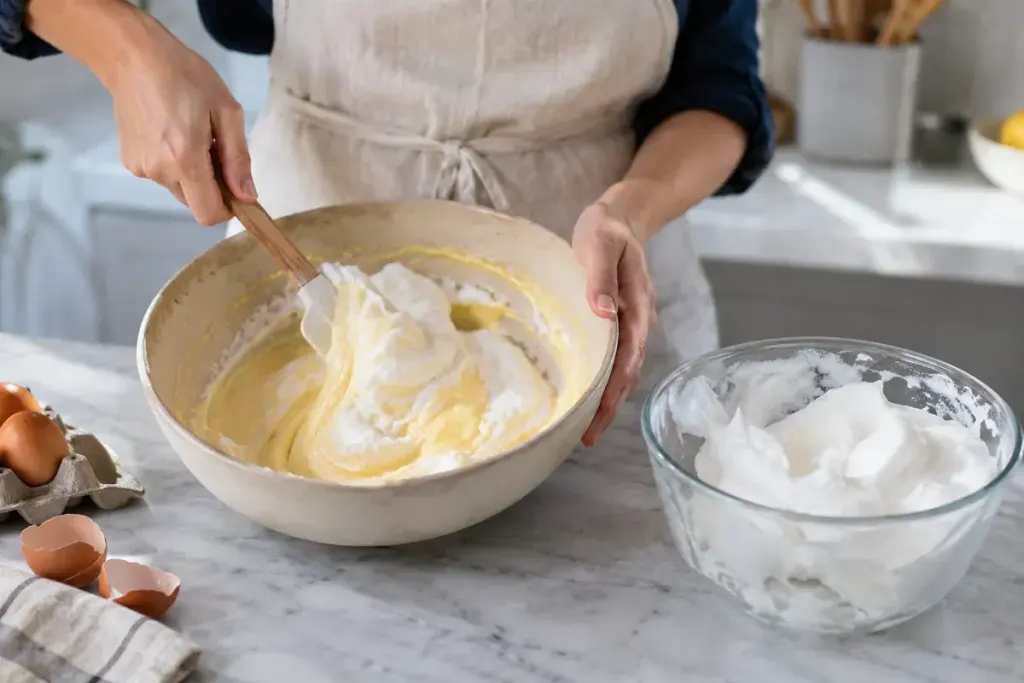
A bowl of whipped egg whites looks wonderfully airy until it meets a heavier batter. Folding is the attempt to combine the mixtures while keeping as much useful aeration as the recipe requires. It needs a different motion from beating everything smooth.
Prepare before the whites are ready
Have the rest of the recipe, tin and oven arrangements ready as directed. Use the specified stage of whipped whites; a recipe asking for soft peaks is not improved automatically by whipping to the stiffest possible texture.
Choose a bowl with room to move and a flexible spatula that can reach its base. If the recipe tells you to mix a small portion of whites into the heavier batter first, follow that step. It can loosen the mixture before the more delicate folding stage.
- Cut down through the mixture with the spatula.
- Sweep along the bottom to bring heavier batter upward.
- Lift it over gently, then rotate the bowl.
- Repeat while checking for pockets at the base and sides.
The motion should combine the whole bowl, not only circulate the top layer. A few deliberate folds are more useful than many shallow strokes that leave dense batter underneath.
Know what you are trying to remove
Large unmixed pockets can create uneven texture, but continuing indefinitely to eliminate every faint visual trace can cost volume. Use the recipe’s description and inspect the mixture carefully. There is no universal fold count because bowl shape, batch size and batter consistency differ.
Do not taste raw egg batter as a doneness check. Transfer and bake according to the tested recipe, and judge the result after its required cooling stage.
For the next attempt, note whether the batter was visibly streaky at the bottom, whether it lost much volume and how the baked crumb behaved. That gives you a specific adjustment to practise. The objective is an evenly combined batter with the structure the recipe needs, not a performance of the gentlest possible movement.