
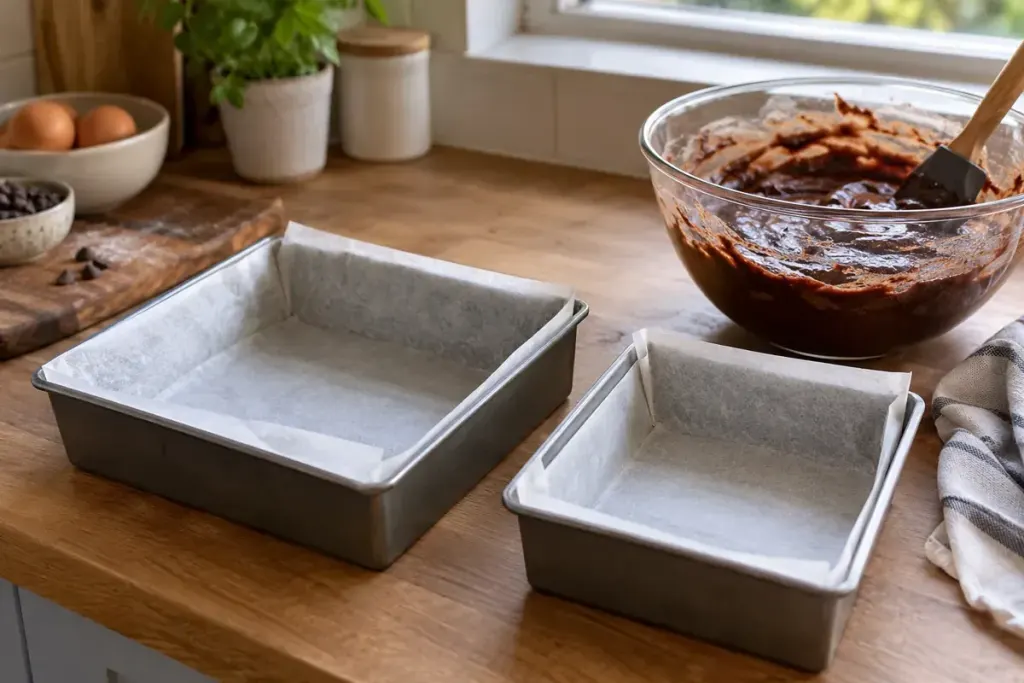
The recipe calls for a square tin, but the one in your cupboard looks almost the same size. Pouring in the batter is easy. Predicting the result requires a little more thought: even a modest increase in width can spread the mixture much thinner.
A pan substitution is best treated as a change to the recipe’s baking conditions. Start with the dimensions and material before deciding whether to use it, scale the batch or choose another recipe.
Measure the usable base
For a rectangular pan, multiply the internal length by the internal width. An illustrative 20 × 20 cm pan has a base area of 400 square centimetres; a 23 × 23 cm pan has 529. With the same quantity of batter and similarly shaped sides, the second spreads the mixture over roughly one-third more area. The initial batter layer will therefore be shallower.
This comparison is a planning aid, not an exact baking-time calculator. Sloping sides, rounded corners and the batter itself complicate the picture. Use the recipe’s intended pan where possible, especially when you have not baked that recipe before.
Keep the material in the conversation
A pan’s colour and material also affect how it bakes. King Arthur Baking’s guide to baking pans discusses the differences between common materials and finishes. That is a useful reason to record more than the width in your baking notes.
If you change both the pan size and the material, a different result becomes harder to interpret. For a first comparison, keep the recipe, oven position and other conditions as consistent as you can. Follow any temperature adjustment specifically provided by the recipe author for the alternative pan.
Do not turn an area ratio into a promise
Scaling ingredients by a simple area ratio can help maintain a similar starting depth, but it does not guarantee an identical bake. Eggs may become awkward fractional quantities, the new pan may have a different depth and the oven may behave differently with a larger load. Never fill a shallow pan beyond what it can safely contain.
For a casual home batch, finding a tested recipe for the tin you own may be easier than redesigning another one. If you do adapt, write down the actual ingredient weights and use the recipe’s described signs of doneness alongside the timer.
Make the next batch easier
Keep four notes: pan dimensions, material, ingredient quantity and what the finished centre and edges were like after cooling. A photograph of the cross-section can be useful if you are comparing batches, provided the lighting is similar.
If the brownies are much thinner than you wanted, the area comparison gives you a sensible place to start. It does not mean the recipe failed. It means the pan changed an important part of the bake. Once the slab is ready, let the cutting method match its texture.