
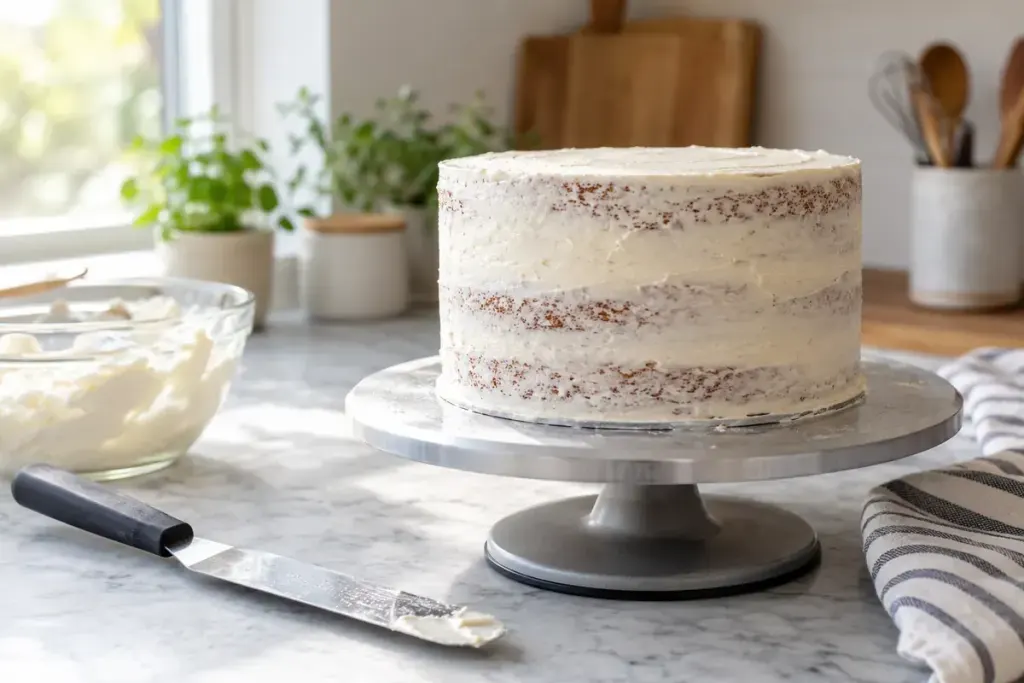
The first sweep of icing picks up a trail of dark cake crumbs. Adding more icing immediately can spread them across an even larger area. A crumb coat gives those loose pieces somewhere to stay before the decorative layer goes on.
King Arthur Baking’s demonstration uses a thin preliminary layer to hold crumbs in place. It is a preparation layer, so a little cake showing through is not a failure.
Work with a cake that can tolerate handling
Follow your recipe’s cooling and storage directions. A warm, fragile cake and a soft filling can make even careful spreading difficult. Set the cake on a stable board or turntable and remove obvious loose crumbs gently before beginning.
Keep a separate small portion of icing for the crumb coat. If the spatula picks up crumbs, avoid carrying them into the clean bowl intended for the final finish. A second scraper or a small receiving bowl can help keep that separation clear.
Thin and even beats thick and perfect
Apply enough icing to cover and trap crumbs without building the finished thickness. Work around the sides and across the top with light pressure. If an area tears, pause and review the cake’s condition and the icing consistency instead of repeatedly scraping the same spot.
Let the coat firm according to the recipe and icing type before adding the final layer. Chilling requirements vary with the filling and frosting; do not leave a perishable cake at room temperature simply because a decorating tutorial uses a different recipe.
For an original practice exercise, crumb-coat a small plain cake and photograph it before the finish. After adding the final layer, compare where crumbs remained visible. The comparison can reveal whether the first coat was missed at an edge or disturbed before it set.
The crumb coat does not need to win a beauty contest. Its success appears later, when the finishing spatula moves across a stable surface and the clean icing stays clean. Stop at that useful stage instead of trying to make the hidden layer look like the final cake.