
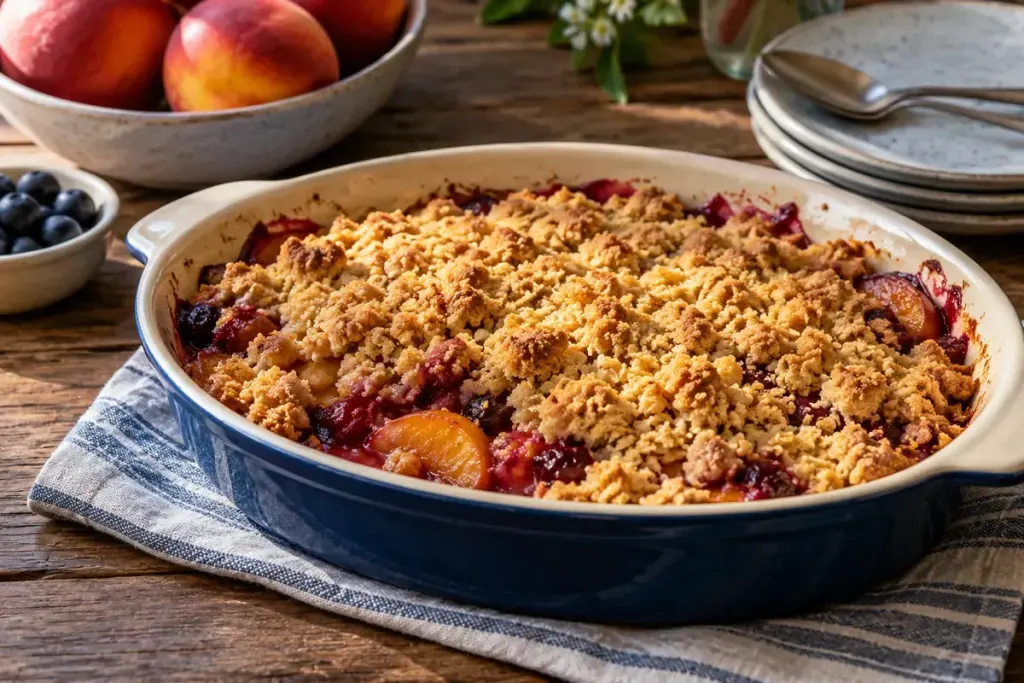
The topping looked crumbly in the bowl but became a flat lid once it reached the fruit. That change often happens during assembly: pressing the mixture down can remove the irregular spaces and clumps that give a crumble its intended texture.
Follow the recipe’s mixture before changing the coverage
Crumble formulas differ. Some begin with cold fat, others with melted butter, and additions such as oats or nuts change the texture. Use a tested recipe and its stated method; this guide concerns placing the prepared topping, not replacing the ingredient ratios.
Look at the mixture before scattering it. If the recipe calls for clumps, gently gather some larger pieces while retaining smaller crumbs. Avoid turning the entire bowl into one compressed mass. If it is unexpectedly wet or powdery, review the measurements and recipe instructions before improvising.
Scatter rather than seal
Distribute the topping across the filling in a reasonably even layer, letting individual pieces keep their shape. Pay attention to corners and edges without packing them tightly. Use the dish size and filling depth specified by the recipe; a much deeper dish changes more than the appearance of the topping.
For a small comparison, prepare two ramekins from the same recipe. Scatter one topping lightly and press the other more firmly. Bake according to an appropriate small-dish version of the recipe and compare the resulting surface. This is a kitchen experiment, not a promise that one treatment suits every dessert.
- Keep ingredient substitutions separate from the assembly test.
- Record the dish dimensions.
- Observe both topping colour and the filling’s stated doneness cues.
- Allow the recommended cooling time before judging texture.
A browned surface does not necessarily mean the filling is ready. Follow the complete recipe’s guidance and use food-safety advice relevant to its ingredients.
When the result works, photograph the topping just before baking. That reference can be more useful next time than a note saying only “make it crumbly,” because it shows the distribution and clump size you actually used.