
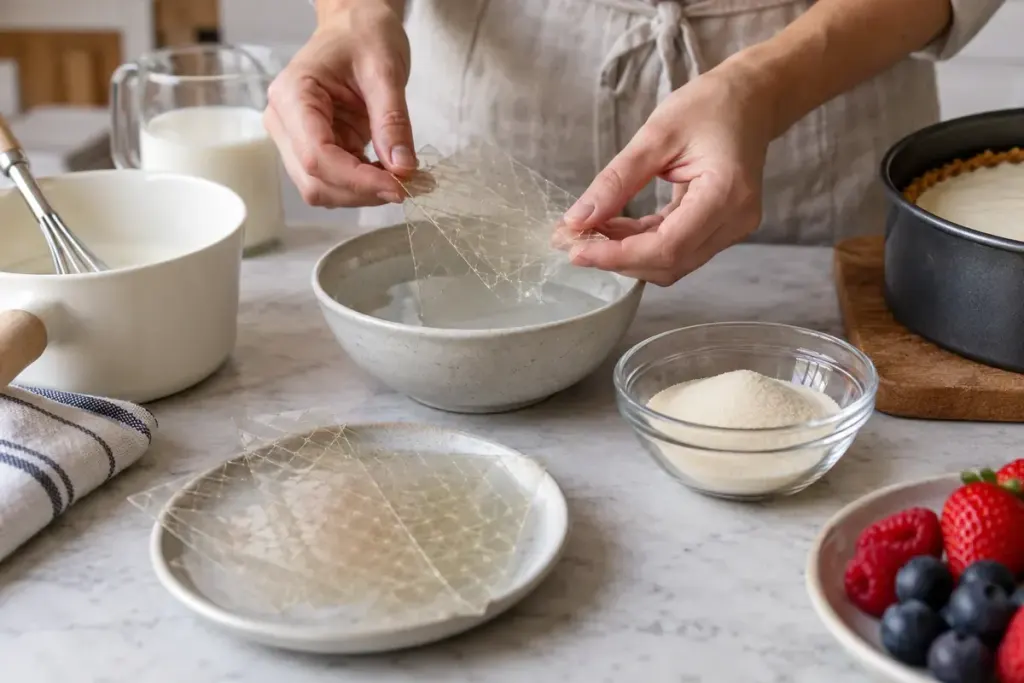
A dessert recipe asks for three gelatine leaves, but the cupboard contains powder. Replacing them by eye can produce a topping that barely holds or a filling that feels much firmer than intended.
The difficulty is that a leaf is a product unit, not a universal measure of setting power. Leaf size, weight and gelatine strength can vary. Powder also needs to be interpreted using its own instructions and the recipe’s intended result.
Find the missing specification
Identify the brand or strength used in the recipe if that information is available. Then read the substitution guidance on the product you actually own. Manufacturer advice, such as the gelatine information in Dr. Oetker’s product FAQs, is more useful than assuming every leaf equals the same spoonful of powder.
If the recipe gives only a leaf count and no further detail, ask its author or use a tested recipe written for your available product. Guessing may be acceptable for a private experiment, but record it as an experiment rather than a reliable conversion to share with others.
Keep hydration separate from the recipe liquid
Follow the packet’s method for soaking or hydrating the gelatine and incorporating it into the mixture. Note whether any added liquid contributes to the recipe’s total. Do not transfer the handling instructions for leaves automatically to powder or change heating steps without checking the product guidance.
For a brownie topping, test a small portion with the intended filling ingredients and chill it under the recipe’s conditions. A mixture that appears firm in a deep cup may behave differently as a thin layer cut into squares, so test the intended serving format too.
Write down the product, quantity, liquid amount, chilling period and texture. Changing one ingredient at a time makes the next attempt informative. Once the substitution works, the note becomes a reproducible version of your recipe rather than a memory of “roughly one spoon.”