
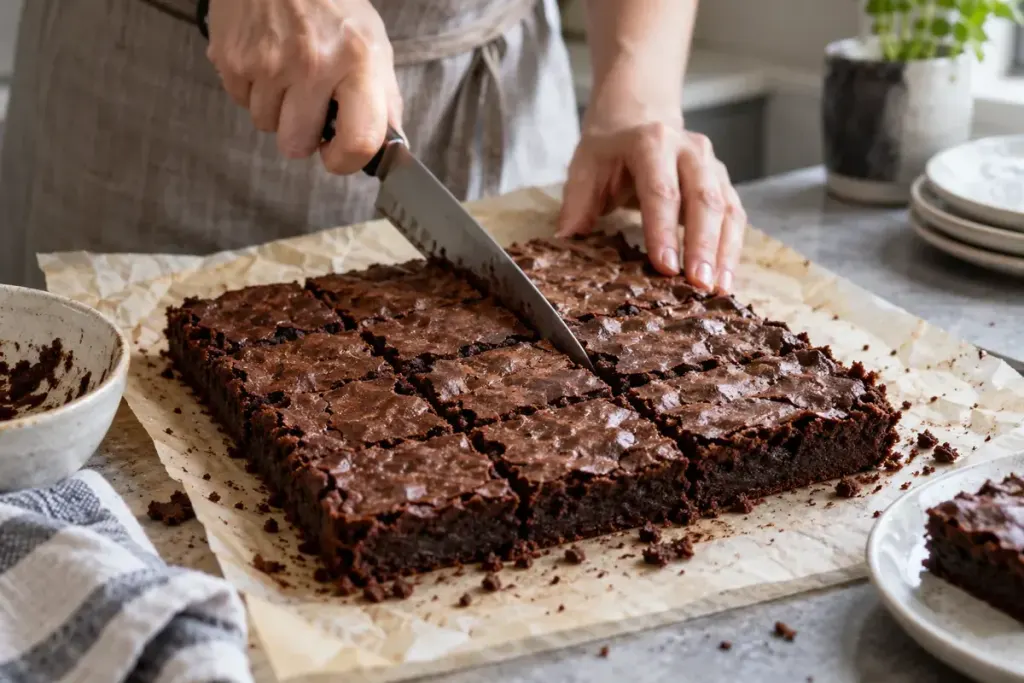
The first square lifts away beautifully. The second collapses into crumbs, and suddenly a neat tray of brownies becomes a plate of very good-looking rubble. Before changing the recipe, notice what kind of break you are seeing.
A warm, soft centre smearing onto the knife is a different problem from a dry slab breaking apart after it has cooled. The response should be different too. Start with the condition of the bake, then look at the way it was moved and cut.
Let the recipe finish at the cooling stage
Cooling is part of the method, not merely a delay before eating. Follow the recipe’s instructions about resting in the pan and transferring the slab. If you want very tidy portions for sharing, plan enough time for that stage before guests arrive.
King Arthur Baking’s fudge brownie recipe, for example, directs the baker to cool the brownies before cutting. That instruction belongs to that particular tested recipe; another style or topping may have its own handling needs.
If you prefer a warm brownie to eat with a spoon, a perfect square may not matter. Decide which result you want before treating a softer serving style as a baking error.
Give the slab support
When the recipe allows a parchment sling, leave enough overhang to lift the cooled bake evenly. Move it onto a stable cutting board with support underneath. Avoid suspending a heavy slab by one small corner of paper or cutting directly into a coated pan.
Plan the portions before making the first cut. A few shallow marks along the edges can help keep the rows even. Use a suitable sharp knife carefully, keep fingers clear and clean the blade between cuts when sticky residue starts dragging the surface.
Read the crumbs before changing ingredients
A dry, fragile result can have several causes, including measurement differences or baking longer than the recipe intended. Compare your notes with the original method. Was flour weighed or packed into a cup? Did you change the pan? Were you waiting for a completely clean skewer when the recipe described a different endpoint?
A hypothetical baker who changed to a larger tin and kept the original time has altered more than presentation. The batter may have been shallower. Our pan-depth guide explains that comparison before the next batch goes into the oven.
Change one useful thing next time
Keep the recipe unchanged while correcting a clear handling problem. If the slab was sliced while warm, try the specified cooling period first. If the issue remains after cooling, review the measurements and baking conditions rather than adding ingredients at random.
Record the observation in plain language: dry edge, sticky middle, cracked surface or crumbly throughout. Those details are more useful than simply writing bad texture. And if a fully baked batch tastes good but will not form neat squares, serving smaller pieces in bowls can make dessert enjoyable while your notes improve the next attempt.